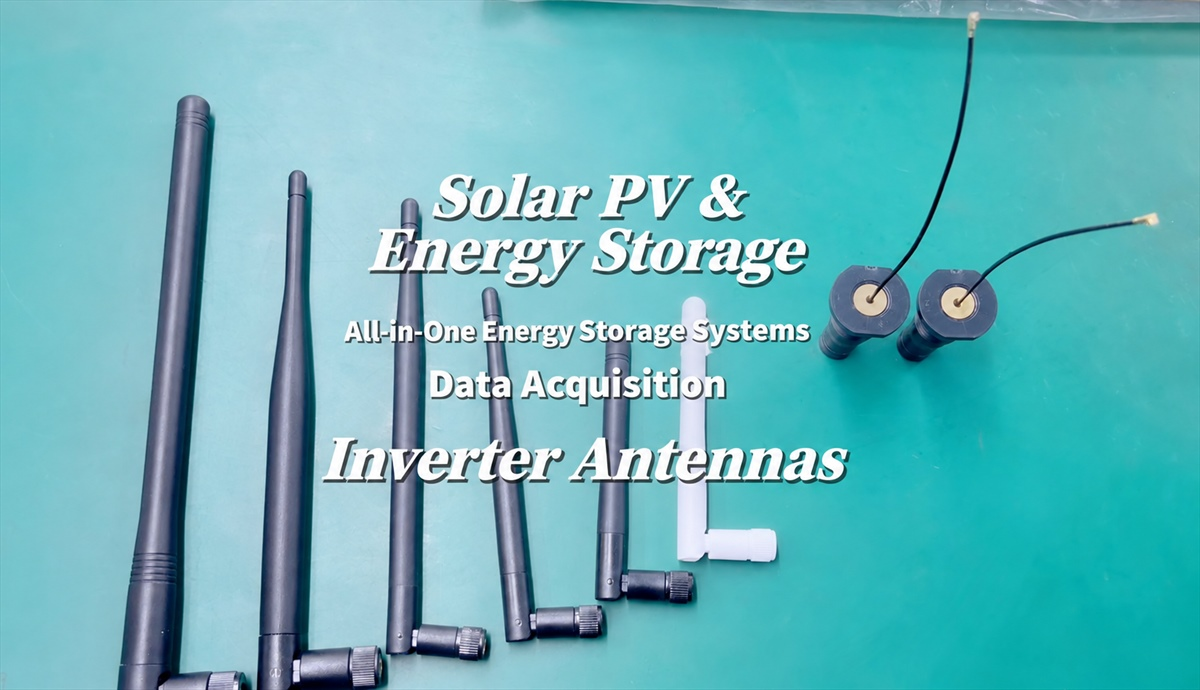
Yanchuang Communications’ micro-inverter antennas support remote monitoring via a mobile app through an external Wi-Fi antenna.
Commercial and Industrial Inverter Antennas
Designed specifically for commercial and industrial settings, these antennas enable high-speed data communication and energy management simultaneously, and support interconnection among multiple devices.
Energy Storage Inverter Antennas
Used in energy storage systems to enable wireless communication between the battery management system and external devices.

Technical Features
Compact Design: Small footprint and easy to integrate, making it suitable for distributed energy systems.
Stable Transmission: Utilizes 5G, IoT, and other technologies to ensure signal stability and interference resistance.
Flexible and Adjustable: Supports frequency adjustment (e.g., 824–960 MHz/1710–2690 MHz) to adapt to the needs of different scenarios.
Typical Application Scenarios
Includes photovoltaic energy storage systems, energy storage batteries, all-in-one energy storage units, commercial and industrial inverters, and residential energy storage equipment.
Performance Specifications for Inverter Antennas
The performance specifications for inverter antennas (typically referring to antennas designed for use with inverters in wireless communication systems) are similar to those of conventional antennas, but they must be matched to the inverter’s operating characteristics (such as frequency and power). The following are the key specifications:
Operating Frequency and Bandwidth
Center Frequency: The optimal resonance point of the antenna design, which must match the inverter’s output frequency (e.g., 433 MHz, 868 MHz, etc.)
Bandwidth: The frequency range supported by the antenna, which must cover the inverter’s operating band; however, an excessively wide bandwidth may reduce gain

Gain and Directivity
Gain (dBi/dBd): Indicates the signal’s ability to concentrate in a specific direction; higher gain results in longer communication distances but a narrower coverage angle
Polar pattern: Describes the spatial distribution of radiated energy, which affects signal coverage
Impedance Matching and Voltage Standing Wave Ratio (VSWR)
Input Impedance: Must be matched to the inverter’s output impedance (typically 50 Ω or 75 Ω) to minimize reflection loss
VSWR: Measures the degree of impedance matching; a lower value (e.g., <2:1) indicates better matching
Polarization
Includes linear polarization (vertical/horizontal) and circular polarization; must align with the system design to avoid signal attenuation
Efficiency and Losses
Antenna efficiency (radiated power/input power) is affected by conductor and dielectric losses; a highly efficient antenna can improve the inverter’s overall performance
Environmental Adaptability
Protection rating (e.g., IP65) and weather resistance ensure stable operation in the inverter’s working environment
Practical Application Considerations
Frequency Matching: A frequency mismatch between the antenna and the inverter can cause signal reflection and reduce communication range
Gain Selection: High-gain antennas are suitable for directional communication (such as long-distance communication), while low-gain antennas are suitable for omnidirectional coverage
Installation Location: Avoid metal obstructions and ensure the antenna is aligned with the communication target
For more information on specific inverter antenna models or case studies, please contact Yanchuang Communications via WhatsApp or phone at +86 18576724139 to learn more.
Shenzhen Yanchuang Communication Technology Co., Ltd. offers a wide range of products, including various inverter antennas, GPS antennas, 4G/5G antennas, vehicle-mounted antennas, Wi-Fi antennas, and RF connectors. These products are widely used in photovoltaic energy storage systems, network communication terminal products, outdoor wireless coverage, communication base stations, smart wearable devices, and smart home applications. The company also provides EMC testing and solutions and supports custom antenna development for antenna manufacturers, making it a one-stop provider of wireless solutions.